
Carnivorous plants suitable for outdoor cultivation
Growing carnivorous plants outside the protection of residential areas can be a challenge, but one that may captivate many gardeners. Carnivorous plants suitable for outdoor cultivation must be chosen carefully, and this guide is here to help you.
Temperature zones
The most important thing to know when selecting plants for outdoor cultivation, whether in a large pot or a bog garden, is understanding the temperature zones in which the plants naturally grow.
A bit of theory: the most widely used system for determining temperature zones is the USDA system, which divides the world into thirteen temperature zones based on the lowest average annual temperatures. The lower the number, the colder the temperatures.

For example, in the Czech Republic, temperature zones 6–8 are found.
In more detail: zone 6b (-20.6°C to -17.8°C), 7a (-17.8°C to -15°C), 7b (-15°C to -12.2°C), 8a (-12.2°C to -9.4°C), 8b (-9.4°C to -6.7°C).
For a detailed view of the Czech Republic, you can refer to this link (note that temperatures on the interactive map are shown in °F, while °C are provided for the range above the map). There you will find an interactive map of the country, allowing you to find the temperature zone corresponding to your location.
Carnivorous plants suitable for the temperature zones of Central Europe
Carnivorous plants can be found in most temperature zones. For outdoor cultivation, we will focus on temperate species that ideally occur in the same or lower temperature zones as those in our garden.
The USDA values for each species are only indicative, based on their most common occurrence in the wild. When determining final suitability, it is important to consider the specific localization of the plants.
Fully frost-resistant carnivorous plants
These plants can be cultivated outdoors without the need for protection against extreme temperatures during sudden winter nights.
Aldrovanda vesiculosa – USDA zone 7
Bladderworts
Utricularia bremii – USDA zone 7
Utricularia intermedia – USDA zone 6
Utricularia minor – USDA zone 6
Utricularia ochroleuca – USDA zone 7
Utricularia vulgaris – USDA zone 5
Utricularia × neglecta – USDA zone 5
Sundews
Drosera anglica – USDA zone 2
Drosera filiformis var. filiformis – USDA zone 6
Drosera linearis – USDA zone 2
Drosera intermedia (temperate, not from tropical South America) – USDA zone 5
Drosera rotundifolia – USDA zone 3
Drosera × eloisiana – USDA zone 6
Drosera × obovata – USDA zone 2
Sarracenia
Sarracenia flava – USDA zone 6
Sarracenia oreophila – USDA zone 6
Sarracenia jonesii – USDA zone 6
Sarracenia purpurea subsp. purpurea – USDA zone 2
Other Sarracenia species besides the ones mentioned – USDA zone 7
Butterworts
Pinguicula apuana – USDA zone 6
Pinguicula alpina – USDA zone 5
Pinguicula corsica – USDA zone 6
Pinguicula grandiflora – USDA zone 6
Pinguicula hirtiflora – USDA zone 7
Pinguicula leptoceras – USDA zone 5
Pinguicula longifolia – USDA zone 7
Pinguicula macroceras – USDA zone 5
Pinguicula vulgaris – USDA zone 5
Pinguicula villosa – USDA zone 2
Partially frost-resistant carnivorous plants
Darlingtonia californica – USDA zone 9, with frost protection USDA zone 7
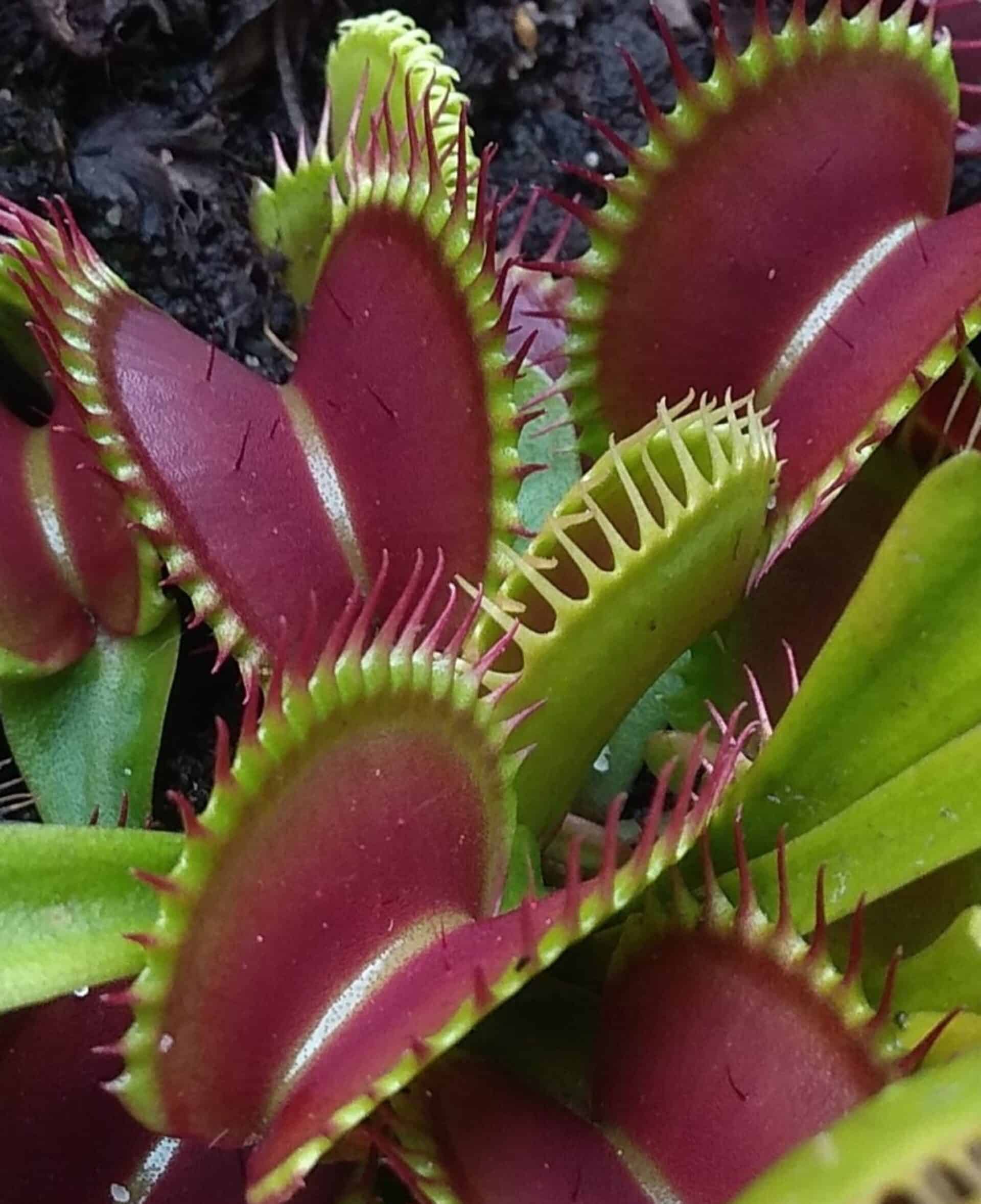
Venus Flytrap (Dionaea muscipula) – USDA zone 7, with frost protection USDA zone 6
Sundews
Drosera binata – USDA zone 9, with frost protection USDA zone 7
Drosera filiformis tracyi – USDA zone 8, with frost protection USDA zone 6
Drosera × hybrida – USDA zone 7, with frost protection USDA zone 6
Sarracenia
Sarracenia rosea – USDA zone 8, with frost protection USDA zone 6
Sarracenia minor – USDA zone 8, with frost protection USDA zone 6
Sarracenia psittacina – USDA zone 9, with frost protection USDA zone 7
Butterworts
Pinguicula caussensis – USDA zone 9, with frost protection USDA zone 7
Pinguicula crystallina – USDA zone 9, with frost protection USDA zone 7
Pinguicula dertosensis – USDA zone 8, with frost protection USDA zone 6
Pinguicula christinae – USDA zone 8, with frost protection USDA zone 6
Pinguicula lusitanica – USDA zone 9, with frost protection USDA zone 7
Pinguicula poldinii – USDA zone 8, with frost protection USDA zone 6
Pinguicula reichenbachiana – USDA zone 9, with frost protection USDA zone 7
The above values are crucial for the successful survival of plants during winter. However, they are not the only criteria for ensuring successful overwintering. The plant’s good health, achieved through adequate conditions during the growing season and proper care, is also essential.